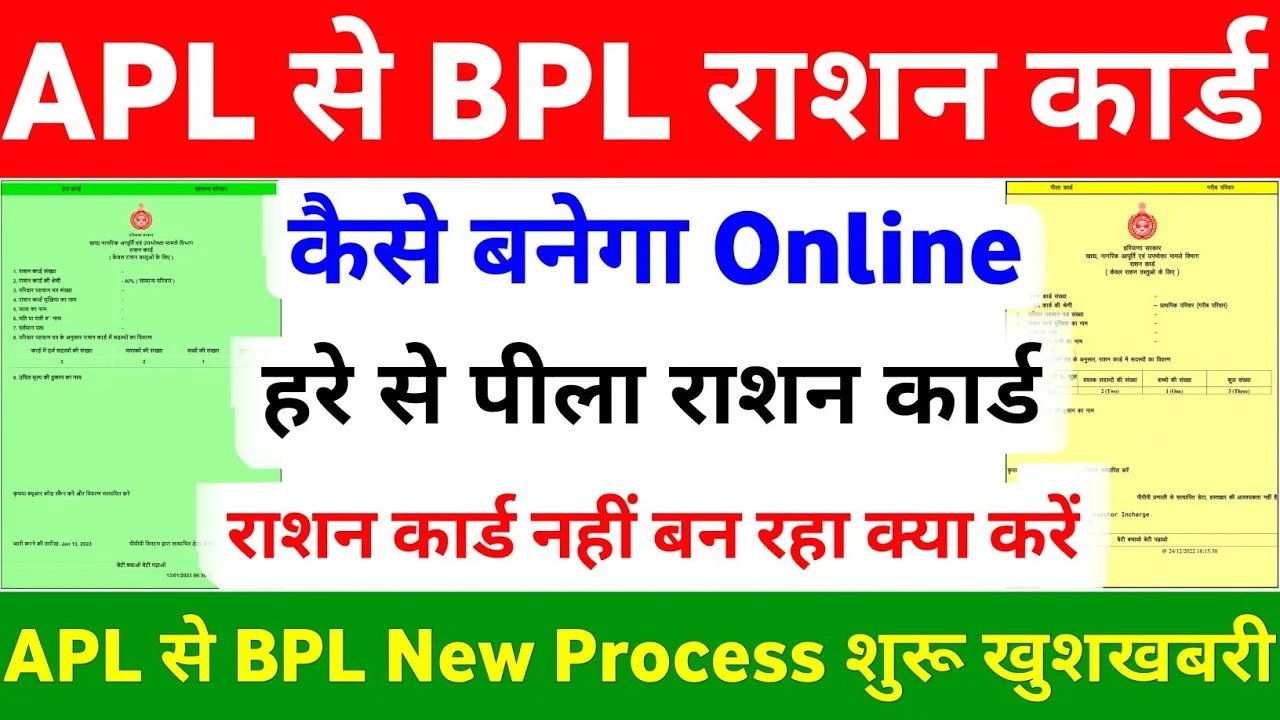
APL to BPL Ration Card: Access to affordable food is a fundamental necessity for every household. To support economically weaker sections of society, the Government of India provides subsidized food grains through the Public Distribution System (PDS). Ration cards play a crucial role in availing these benefits.
APL to BPL Ration Card
APL to BPL Ration Card Families are generally categorized under Above Poverty Line (APL) and Below Poverty Line (BPL) based on their income and economic condition. If a family’s financial situation worsens and they meet the eligibility criteria, they can apply to convert their APL ration card into a BPL ration card.M
With the introduction of online services, the process has become faster, more transparent, and more convenient. This guide explains the benefits, eligibility requirements, application process, and frequently asked questions regarding APL to BPL ration card conversion.
What Is the Difference Between APL and BPL Ration Cards?
APL Ration Card
An APL ration card is issued to families whose income is above the poverty line. These cardholders may receive limited benefits under government food distribution schemes.
BPL Ration Card
A BPL ration card is provided to families living below the poverty line. It allows beneficiaries to purchase essential food items such as rice, wheat, sugar, and kerosene at highly subsidized rates.
Benefits of Converting an APL Ration Card to a BPL Ration Card
APL to BPL Ration Card Converting an Above Poverty Line (APL) ration card to a Below Poverty Line (BPL) ration card can provide several important benefits to eligible families facing financial difficulties. The BPL category is specifically designed to support low-income households by offering access to subsidized food items and various government welfare schemes.
Subsidized Food Grains
- BPL cardholders can purchase essential food items such as rice, wheat, sugar, and other commodities at significantly lower prices through the Public Distribution System (PDS).
Access to Government Welfare Schemes
- Many central and state government welfare programs prioritize BPL families, including housing assistance, healthcare benefits, educational support, and financial aid schemes.
Improved Food Security
- A BPL ration card helps ensure a steady supply of essential food items, reducing the risk of food shortages and improving the overall well-being of the family.
Financial Savings
- By receiving food grains and essential commodities at subsidized rates, families can reduce their monthly household expenses and allocate their income to other important needs.
Priority in Social Assistance Programs
- BPL families often receive preference in various social welfare initiatives, including pension schemes, scholarships, and employment programs.
Healthcare Benefits
- Several government health insurance and medical assistance programs are available exclusively to BPL households, helping reduce healthcare expenses.
Educational Support
- Children from BPL families may be eligible for scholarships, free textbooks, uniforms, and other educational benefits provided by government agencies.
Housing and Utility Assistance
- BPL cardholders may qualify for affordable housing schemes, electricity subsidies, and other public assistance programs aimed at improving living standards.
Easier Access to Financial Assistance
- Many government loans, grants, and livelihood support programs use BPL status as an eligibility criterion, making it easier for beneficiaries to access financial help.
Enhanced Social Security
- A BPL ration card acts as proof of economic status and helps families receive targeted support during emergencies, natural disasters, or periods of economic hardship.
Eligibility Criteria for APL to BPL Conversion
APL to BPL Ration Card Eligibility requirements may vary from state to state. Generally, applicants must:
- Belong to a low-income household.
- Fall below the income limit specified by the state government.
- Not own substantial assets or properties.
- Provide valid proof of financial status.
- Meet other state-specific conditions.
APL to BPL Ration Card Documents Required
The following documents are commonly required:
- Existing APL Ration Card
- Aadhaar Card of family members
- Income Certificate
- Address Proof
- Identity Proof
- Passport-size Photographs
- Bank Account Details (if required)
- Any additional documents requested by the local authority
Google Pay Loan Apply Online 2026: Get Instant Personal Loan in Just 10 Minutes
Step-by-Step Process to Apply Offline for APL to BPL Ration Card Conversion
Step 1: Visit the Official Website
- APL to BPL Ration Card Go to the Food and Civil Supplies Department website of your state.
Step 2: Register an Account
- Create a user account using your mobile number, email address, and personal details.
Step 3: Fill Out the Application Form
- Select the option for ration card modification or category change and complete the required information.
Step 4: Upload Documents
- Upload scanned copies of all required supporting documents.
Step 5: Review the Application
- Carefully verify all details before submission.
Step 6: Submit the Application
- Submit the application and save the acknowledgment or reference number.
Step 7: Track Application Status
- Use the reference number to monitor the progress of your application online.
Step 8: Verification Process
- Government officials may conduct document verification and field inspections.
Step 9: Approval and Issuance
- Once approved, your ration card category will be updated, and you will receive the BPL ration card benefits.
Apply Offline for APL to BPL Ration Card Conversion
APL to BPL Ration Card If online application services are unavailable in your area or you prefer the traditional method, you can apply for the conversion of your APL ration card to a BPL ration card through the offline process. Follow these steps:
Step 1: Visit the Nearest Ration Office
- Visit your local Food and Civil Supplies Department office, Taluka office, or ration card service center responsible for handling ration card applications.
Step 2: Collect the Application Form
- Request the APL to BPL ration card conversion form from the concerned office. In some states, the form may also be available at Common Service Centers (CSCs).
Step 3: Fill Out the Application Form
- Name of the head of the family
- Family member information
- Current ration card details
- Residential address
- Income details
- Occupation information
Step 4: Attach Required Documents
- Existing APL ration card
- Aadhaar cards of family members
- Income certificate
- Address proof
- Identity proof
- Passport-size photographs
- Any additional documents required by local authorities
Step 5: Submit the Application
- Submit the completed application form along with the required documents to the designated office. Ensure that all documents are properly attached and signed where necessary.
Step 6: Obtain an Acknowledgment Receipt
- After submission, collect the acknowledgment receipt or application number. This receipt serves as proof that your application has been submitted.
Step 7: Verification Process
- Government officials may verify the information provided in the application. This can include document verification and a field visit to confirm the family’s economic condition and residence details.
Step 8: Approval by Authorities
- Once the verification process is completed, the concerned department will review your application and determine whether you qualify for BPL status.
Step 9: Receive the Updated Ration Card
- If your application is approved, your ration card category will be changed from APL to BPL. You can collect the updated ration card from the designated office or receive it through the method specified by your state’s authorities.
Common Reasons for APL to BPL Ration Card Application Rejection
APL to BPL Ration Card While applying for the conversion of an APL ration card to a BPL ration card, it is important to ensure that all information and documents are accurate. Applications may be rejected for several reasons, including the following:
- Incorrect or False Information
- Providing inaccurate details regarding income, family members, address, or other personal information can lead to application rejection during verification.
- Incomplete Application Form
- Leaving mandatory fields blank or submitting an incomplete application form may result in the authorities rejecting the request.
- Missing Required Documents
- Failure to upload or submit essential documents such as income certificates, identity proof, address proof, or Aadhaar cards can cause delays or rejection.
- Income Exceeds the Eligibility Limit
- If the applicant’s family income is higher than the limit prescribed by the state government for BPL classification, the application may not be approved.
- Ownership of Significant Assets
- Applicants who own substantial property, vehicles, agricultural land, or other valuable assets may not qualify for BPL status.
APL to BPL Ration Card Frequently Asked Questions (FAQs)
- What is an APL ration card?
- An Above Poverty Line (APL) ration card is issued to families whose income is above the poverty line set by the government. APL cardholders may receive limited benefits under the Public Distribution System (PDS).
- What is a BPL ration card?
- A Below Poverty Line (BPL) ration card is issued to economically weaker families living below the poverty line. It provides access to subsidized food grains and various government welfare schemes.
- Can I convert my APL ration card to a BPL ration card?
- Yes, if your family’s income and economic condition meet the eligibility criteria prescribed by your state government, you can apply for the conversion of your APL ration card to a BPL ration card.
4 Is there any fee for applying for APL to BPL conversion?
- In most states, the application process is free of cost or involves a nominal service fee. Applicants should check with their local Food and Civil Supplies Department for accurate information.
Best Useful Android Apps by Google
Google Pay Loan Apply Online 2026: Click Here
Google Maps App Download: Click Here
Read Along by Google 2026: Click Here
Pradhan Mantri Jan Dhan Yojana 2026: Click Here
PM Mudra Loan Scheme 2026: Click Here